Date : January 27, 2026
To : Young Lawyers
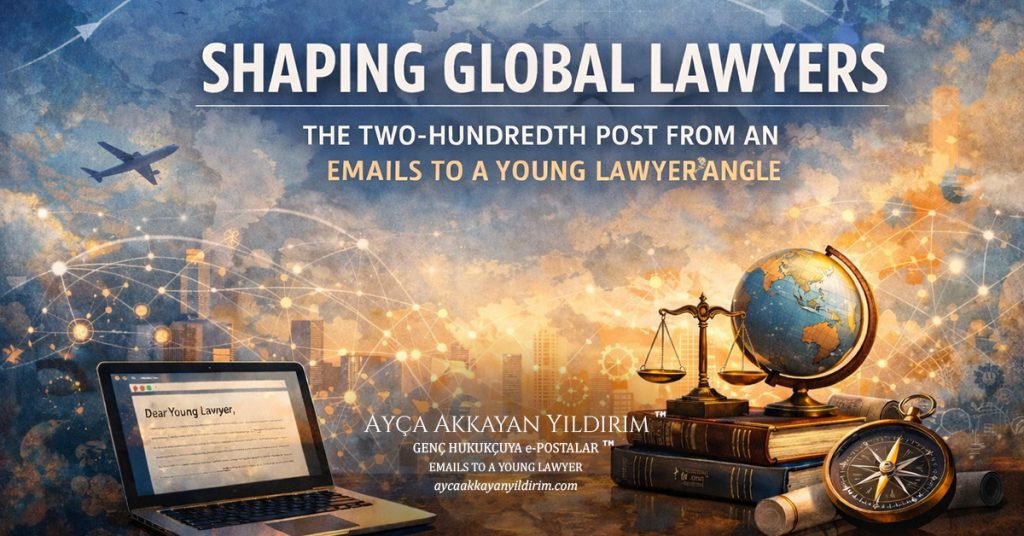
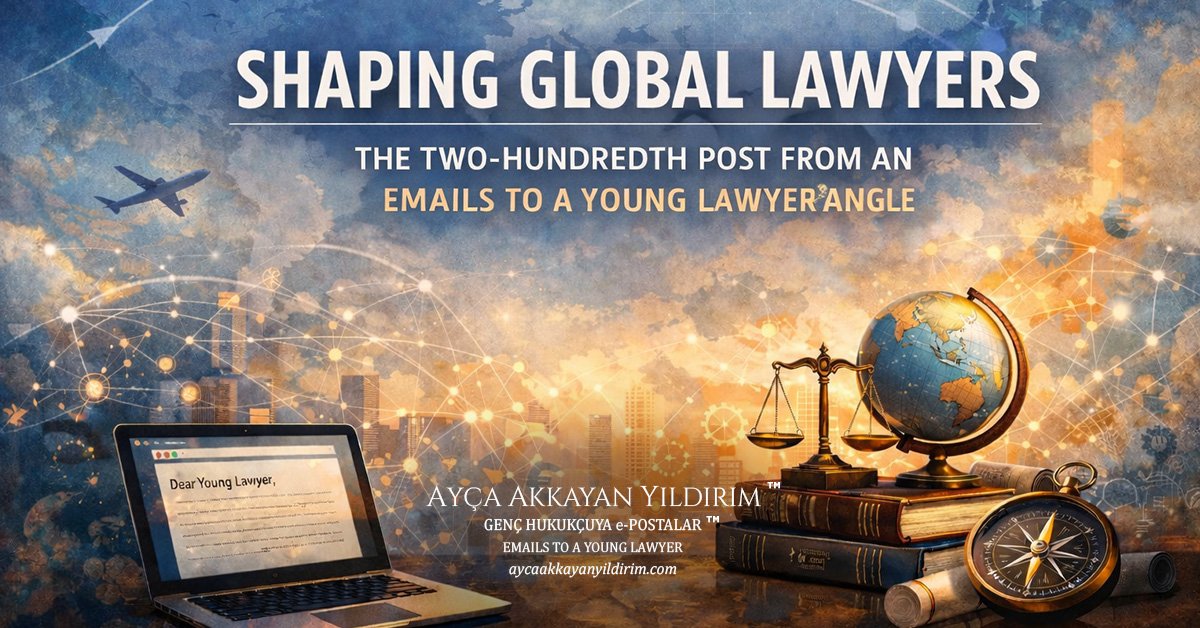
Re : AT THE TURN OF A NEW YEAR: SHAPING GLOBAL LAWYERS:
(THE TWO-HUNDREDTH POST FROM AN “EMAILS TO A YOUNG LAWYER℠ ANGLE”)
At the turn of the new year, I’m not interested in listing personal or professional accomplishments of 2025. Such a list requires a constant, and likely misguided, pursuit of better and more. Accordingly, I’m more interested in noticing where the pace slowed and where there was space to pause and think, both creatively and structurally. I want to identify the times that allow for growth, not through aimless striving, but through precision decisions.
Two Hundred
This instance of looking back also happens to coincide with a milestone: with this post, EMAILS TO A YOUNG LAWYER℠ and its Turkish counterpart, GENÇ HUKUKÇUYA e-POSTALAR™, reach their two-hundredth cumulative post across both languages. Despite its glamor, the number itself isn’t the point. What it reflects, however, is a way of working: returning, over time, to the same core questions about the legal profession and allowing experience to change how those questions are understood. You don’t reach two hundred of anything by moving quickly or chasing new answers. You reach it by staying with the questions long enough for judgment, perspective, and priorities to crystallize.
The Questions That Stay
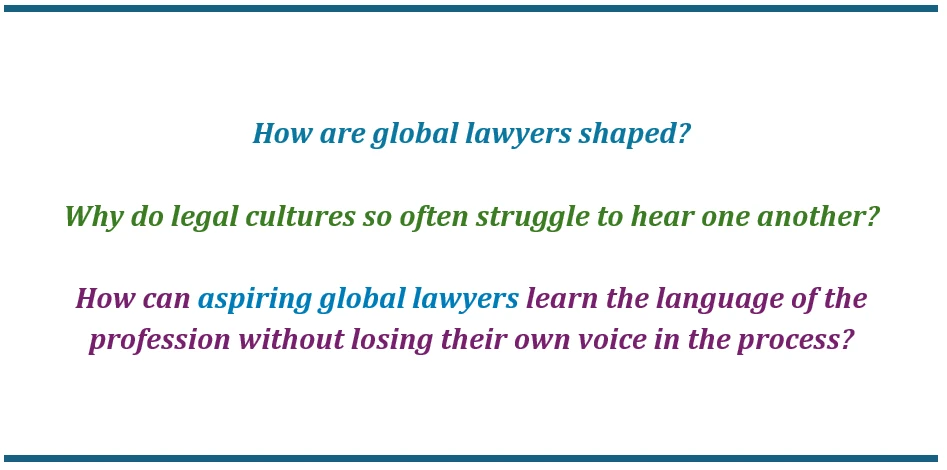
Over the past five and a half years, we carried the conversations that shaped EMAILS TO A YOUNG LAWYER℠ with contemplative levity. We maintained our pursuit of novel answers to the same core questions. How are global lawyers shaped? Why do legal cultures so often struggle to hear one another? And how can aspiring global lawyers learn the language of the profession without losing their own voice in the process?
The In-Between Space
Reflecting on these questions again has brought me back to something I have written about before. Becoming a lawyer is not a straight path; it requires pursuing constant learning to stand between the systems and expectations that shaped you and the professional self you are gradually becoming. I reflected on this more personally in Before I Became a Lawyer, where I wrote about how legal education does more than teach skills. I sought to explain how it shapes you and your place in the world vis-à-vis my own experience. That in-between space is also where pauses tend to appear, sometimes chosen and sometimes imposed. In that space is where the discomfort signaling that something important is taking shape often emerges.
EMAILS TO A YOUNG LAWYER℠ exists for precisely these moments: the in-between stretches when becoming matters as much as practicing, when thinking is allowed before acting, and when questions are understood as part of professional life. This platform is not a place for quick directions or instant confidence. It is instead a place for reflection whenever possible, and for the kind of attention that makes professional life more grounded. The most compelling young lawyers we encountered on this platform over the past year were not the fastest or the loudest. They were the ones learning how to listen to institutions, to people, and, most importantly, to themselves.
The International Layer
For aspiring global lawyers, this work has an added layer. A single legal issue can be approached through more than one lens, and each lens carries its own cultural, historical, institutional, and educational inheritance. What looks “obvious” in one system may look “incomplete” in another. This is the reality of cross-border practice and of global legal work more broadly. It means that becoming internationally effective requires more than learning or memorizing new rules. It asks that you build the capacity to step back and think: What assumptions does my own training carry? What does this other system assume? What does this institution reward? What does this client expect? That kind of analysis requires both discipline and humility, and it depends on a skill most young lawyers underestimate: precise, patient, and genuinely curious cross-cultural communication — a core global lawyering skill.
If you want a more structured framework for building that capacity, you might also look at my earlier post Beyond Borders: How Global Lawyers Turn Awareness into Action, where I outline a practical toolkit—translation, synthesis, and critique—for turning cross-border awareness into professional competence.
Many young lawyers internalize the idea that if they are not moving at full speed, they must be falling behind. Yet moving below breakneck speed does not equate to a failure of will or a lack of ambition. It can and should involve understanding your circumstances, the demands of the profession, and the global and institutional context you are stepping into. “Why am I slowing down?” is not a helpful question at all. Instead, ask, “Am I slowing down because I’m lost or because I’m learning how to stand correctly in this environment?” Note that in a profession that rewards speed, learning when and why to pause is itself a form of professional maturity.
This kind of confusion often becomes most visible early in a professional’s life. Legal education trains students to operate within defined frameworks, to identify issues, apply rules, and produce arguments that can withstand scrutiny. Through these exercises, expectations are clear, and feedback is meticulous. Practice, by contrast, places lawyers in situations where those frameworks are incomplete. Most often, feedback does not arrive, and judgment must be exercised without the reassurance of a clearly correct answer.
Wherever you receive your legal education, whatever system you are trained in, this shift is built into the profession. Moving from education to practice often feels less like acquiring new knowledge and more like adapting to a different mode of evaluation and a different process entirely. For those who make this transition while moving between legal systems (often from civil law to common law), the adjustment is more complex and layered, requiring global professional judgment and the translation of cultural and institutional norms.
No Single Roadmap
And this is where an important truth deserves to be said plainly: there is no single system, method, program, or course that produces a global lawyer. You will never find “one best way”. The work is more personal than that. It requires strategy: your very own strategy. You have to learn how you learn. You have to identify what you need. You have to build your own global professional architecture around that over time. The goal is not to stumble upon the universal “one best way” and imitate it. It is to develop a way of thinking and communicating that travels well across contexts, without losing rigor or integrity. In other words, it is about becoming a thoughtful global lawyer.
If you are in transition or are preparing for one and do not know the answers, are interrupted, or receive little or no feedback, know that these are part of the process by which global professional judgment is formed. Discomfort, in that sense, is where your work begins.
Pause, Then Reach Out
This is where EMAILS TO A YOUNG LAWYER℠ can meet you. After you have taken the time to think things through and name what you are actually trying to solve, you are welcome to reach out with any questions or uncertainties. What matters most is the pause before the message: the moment when you ask yourself what is truly at stake, why this matters for you, why it matters now, and what kind of clarity you are seeking. From there, conversation can begin. We, as a team, are here for you.
For 2026, I hope you find your orientation by paying close attention to your thinking, your questions, and your experience.
Whenever you get a chance, pause and pay attention to how you think, how you write, how you question, and how you adapt. Long before any titles arrive, these habits, staying with questions and letting experience do its work, are already shaping you in ways that matter.